Cart
0
You may also like



What is tangaliya?
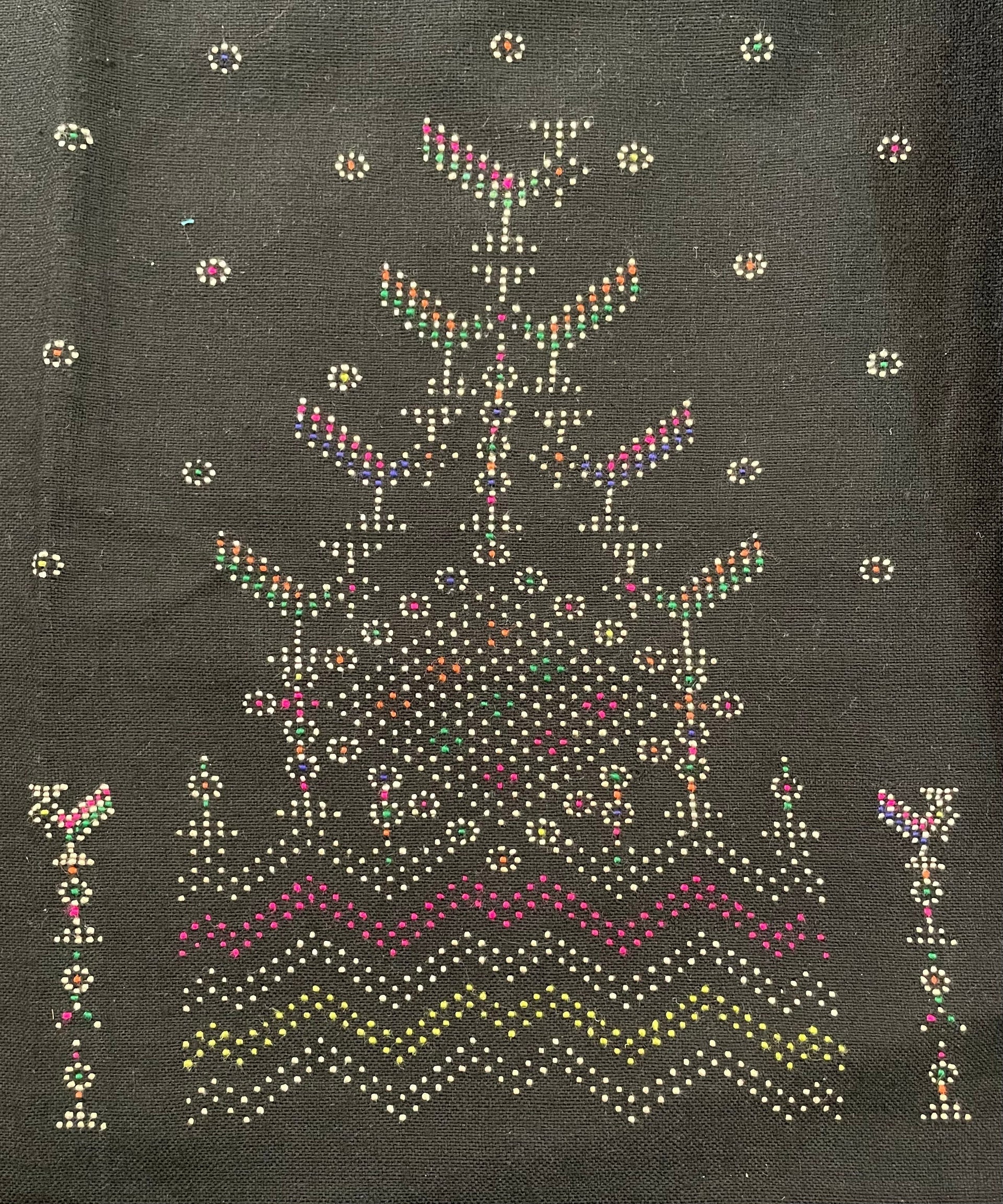
Tangaliya is a unique weaving technique in which small raised dots of thread, called daanas, are created directly within the fabric. These daanas appear on both the sides and feel like tiny beads, almost as if they are embroidered, but they are actually formed during the weaving itself. Because of this, it is also known as daana weaving. The fabric made using this technique is also called Tangaliya.
The word Tangaliya comes from the Gujarati word tangalio, meaning “lower body,” as this fabric was traditionally worn as a lower garment by the Bharwad women.
What makes Tangaliya truly special to me is that these raised daanas can only be made by hand, they cannot be replicated by machines. That is exactly what gives the fabric its distinct texture and a tactile quality that you can immediately feel the moment you touch it.
How Tangaliya Began
Tangaliya weaving is practised by the Dangasia community in Surendranagar, and it was originally made for the Bharwad community of Saurashtra. Bharwads are a pastoral community of Gujarat, known for herding sheep and goats.
Within the Bharwad community, there are two main groups: Motabhai Bharwad and Nanabhai Bharwad. It is believed that this division came from a family where the elder brother married within the community, while the younger brother married a woman from the Koli community, which is considered lower in the social hierarchy. The descendants of these two brothers came to be known as Motabhai Bharwad and Nanabhai Bharwad.
The Dangasia community, who practise Tangaliya weaving today, is believed to have come from the Bharwad community itself. There are two commonly told stories about their origin.
One story talks about a Bharwad family where a father lived with his three sons and their wives. One day, a dead pig was found in their courtyard. Since no one from the Bharwad community was allowed to remove it, the eldest daughter-in-law asked the youngest son to call someone from a lower caste to take it away. Instead of calling anyone, the youngest son picked it up himself using a stick and threw it away. This act was seen as a serious mistake, and he was removed from the community. Before sending him away, he was given the same stick and told to keep it as a sign of his Bharwad identity. It is believed that later he married a woman from the Vankar community.
Another story says that a Bharwad man and a Vankar woman fell in love, but their marriage was not accepted by society. They were asked to live separately.
Both these stories describe a Bharwad man and a Vankar woman living together, away from society, as their relationship was not socially accepted. Over time, the Bharwad community supported them by giving them spun yarn and grains, and in return, the couple wove cloth for them. This exchange is believed to be how the weaving practice began. It is believed that the man learned the weaving technique from the woman. It is fascinating for me to see how one marriage can shape communities, and in this case, even lead to the birth of a whole new craft tradition.
Earlier, they used to weave only plain cloth. But since the Bharwad community prefers rich and detailed designs, they wanted something that looked decorated. I feel this way of thinking is common in pastoral communities. There are many pastoral and nomadic groups in Saurashtra and Kutch, and they often share the same landscape, the grasslands, and similar kinds of work. In such a shared space, textiles became their way of standing apart.
Clothing was never just for covering the body. It was a way to show identity, community, marital status, social position, and more. In that sense, Tangaliya slowly became a strong identity marker for the Bharwad community.
As the Bharwad community wanted richer designs, the couple started experimenting. He first made a single daana, then simple motifs like ladwa, and slowly began taking inspiration from his surroundings. People liked it, and it was accepted over time.
Tangaliya weaving was mainly supported by the Motabhai Bharwads, who felt empathy for the couple and wanted to help them. On the other hand, Nanabhai Bharwads were more rigid and did not accept them as part of the community, so they did not encourage this craft.
Traditionally, Tangaliya was made as a cloth that women wrapped around their waist to cover their legs. Because it was used as a lower garment, it came to be called Tangaliya. Women also had their own specific ways of draping it. Even within the Bharwad community, women from different regions and age groups preferred different designs. It used to be made in wool, as wollen textiles are mostly preferred by the pastoral and nomadic communities to survive from the extreme climatic conditions. Only married women used to wear the tangaliyo (the wrap-around skirt). Just like we commonly see a mangalsutra as a sign of marriage today, in the Bharwad community, Tangaliya itself was an indicator that a woman was married.
Men across most pastoral communities wore similar outfits like kediyu and choini, usually in white cotton. The white colour helped protect them from the harsh sun. For women, clothing was a clear marker of their community. They dressed according to their identity, mostly in black or brown shades. This was because the wool available at that time came from black and brown sheep.
The Tangaliya skirt was worn with a polku or kaapdu (blouse) and an odhni (veil) on top. The kaapdu could be simple or heavily embroidered, depending on the use. The odhni could be from other crafts like tie-dyed or embroidered, or sometimes made using Tangaliya itself. Tangaliya textiles were made from hand-spun wool and were quite heavy and rough in texture.

Traditional Bharwad woman attire
Revival of Tangaliya
The craft of Tangaliya weaving has gone through many hardships. Around 2002–2003, it saw a major decline. Demand dropped sharply, as the traditional products made for the Bharwad community no longer fit their changing lifestyle, and the craft slowly lost its market.
Later, efforts by NIFT and the SAATH Foundation helped bring the craft back. They worked on diversifying the product range, introduced materials like cotton, silk, and acrylic, and explored new colour combinations. Because of this, the craft started gaining attention again, and many artisans who had left the practice returned to it.
Present-Day Products
Nowadays, the craftspeople make both clothing and home furnishing products. In clothing, they make sarees, shawls, dress materials, kurtas, and more. For home, they make items like cushion covers. However, cushion covers are not very practical for them, they need a different loom setup, involve very fine work, and the payment is often not enough for the effort.
Clothing products sell much better than home items. Three-piece dress materials and kurtas are the most popular. Tangaliya is mainly preferred for everyday wear rather than for special occasions.
Making of Tangaliya
The base fabric is first woven in a plain weave. Then, at the required points for making a motif, the weaver inserts an extra weft thread by hand. They pick a small group of warp threads, usually around 4 to 5, based on the design. The extra weft is then wrapped around these threads, twisted, and cut to form a small raised dot. They look like they are part of the weave, but actually they are made separately during the process, giving a bead-like effect.
The daanas are made using cotton or acrylic yarns. These yarns are unplied, as this makes them easier to wrap, twist, and cut while forming the dots. The ground fabric is made with cotton or sometimes silk, depending on what the customer wants. In pieces where silk is used, it is only added in the weft. As it is too brittle to be used in the warp and also it is too slippery for the daanas to stay in place.
Traditionally, the daanas were made in white so that the fine work could stand out clearly against a dark
background. White was an important colour for this reason.
The daanas are very intuitive, their size depends on the person making them. A medium-sized daana, not too big or too small, is usually most appreciated.
Shown below is a diagrammatic representation of how daanas are inserted. It shows the plain weave structure of the base fabric, with the warp and weft clearly arranged. An extra weft thread is then wrapped and twisted around a group of warp threads to form the raised daana.

Design language
The designs and motifs were inspired by their surroundings, along with simple geometric forms. The mor (peacock) is one of the most important motifs in Tangaliya. One reason could be the respect Bharwads have for the peacock, as it is associated with Lord Krishna. It could also be because it was one of the most beautiful animals they saw around them. Other motifs used in tangaliya are savla, navghari, phandi, khajuri, aambo, button, beyaryu, etc.
These designs are often arranged in the form of a jhaad (tree), where a peacock is usually placed at the top. Sometimes, they show a group of peacocks, or peacocks sitting on a mango tree, or near a dairy, or combined with geometric patterns. They also show mor pag (peacock feet) at the bottom of the jhaad.

Khajuri

Phandi

Pandadi

Mor (Peacock)
I feel that the placement of motifs is also guided by the practicality of the technique. Since too many daanas cannot be added in one fabric, they developed a way of arranging motifs in the form of jhaad, using elements from their surroundings. These are placed thoughtfully, on borders, as butas, or on specific parts of a garment like the yoke, sleeves, or edges. In many pieces, a large part of the fabric is left plain, with daanas added only in certain areas. This clearly shows their respect for both the technique and practical design.
Here are some examples of jhaad designs.

Padhro nu jhaad

Amba nu jhaad

Beyaryu nu jhaad

Mor nu jhaad

Deri nu jhaad

Beyaryu nu jhaad

100 year old tangaliya piece

1 half of a tangaliya piece
What I really appreciate is their understanding of maintaining a grid while creating these motifs. The placement is never random, daanas are always arranged in a clear geometric order.
Even today, when designers suggest random or very curvy placements, it doesn’t feel like Tangaliya. This gridbased structure is the real essence of the craft.
From what I have seen, the texture created through Tangaliya is more durable than embroidery and even extra weft. In embroidery or extra weft, the added threads can come off more easily, but the daanas stay intact as they are secured within the structure of the fabric. At the same time, Tangaliya fabric is very lightweight and airy, yet it still has a strong sense of texture and design. This kind of lightness is quite rare, as most textured fabrics, especially embroidered ones, need a thicker base cloth.
Extra-weft weaving also needs a more complex loom setup, with more shafts or even a jacquard system. In contrast, Tangaliya does not require any complex setup. It can be done on a simple pit loom or frame with just two shafts. There is no added mechanism, the skill of the hand is the most important part.
Where It Stands Today
Most of the artisans I met are now working independently. The association formed during the revival by NIFT is not active anymore, so many of those artisans have moved to their own individual practice. Some are connected with government organisations like DIC, and almost all of them have artisan identity cards, which allow them to take part in government exhibitions.
I found the artisans very positive and energetic. They are open to experimenting and are eager to work with designers and learn new ways of thinking. At the same time, they also share their own inputs on designs. Many of them even look for new ideas on platforms like Pinterest and try them out in their free time. However, they find true joy in creating the traditional motifs.
To me, Tangaliya is a strong example of how a craft can evolve while still holding on to its essence. It was originally a wool-based textile made for the Bharwad community, suited to their lifestyle. Over time, wool no longer suited their lifestyles. If the craft had not adapted by changing its materials and products, it could have easily died. This shows how important it is to stay relevant to the needs of the present audience.


