Cart
0
You may also like



I came across beadwork while I was searching for a craft to document for my course at NID. I am from the Saurashtra region of Gujarat, and I already had a little idea about the beadwork tradition there. This made me curious, and I decided to explore and understand this craft better.
For me, beadwork is a very unique tactile experience. I had never seen or touched a surface like this before. What fascinates me most is how these hard, solid beads are transformed into a flexible sheet that behaves like a textile.
How can one define a bead? A bead is a small piece of glass, wood, etc., with a hole through it, and which can be put on a string with others of the same type. Beads are one of the oldest inventions of humankind. These tiny objects were also used as a currency in many cultures across the globe. Beads have existed since the Stone Age, with early examples like ostrich eggshell beads from 10,000 BCE, and physical evidence found from around the 9th century BCE made of shells, seeds, bones, and stones; in Gujarat too, traditions of using strung beads in jewellery date back to the time of the Mohenjo-Daro.
I was really excited for the craft documentation course, as interacting with craftspeople gives me immense joy. Having a conversation with anybody who has maybe not read a lot of books but has a lot of life experiences to share excites me the most. I love one-on-one conversations that reveal how life shapes a person’s perspective. I especially cherish these talks with women; every woman carries a unique story and so much to share. When I learned that women in Saurashtra are leading this craft, I felt even more motivated to talk to them. I have rarely come across a craft led by women, so I was excited to understand their ecosystem.
Aspiring to learn the motif language, technicalities, making process and the artisans’ aspirations about the craft, I started looking for leads in the Saurashtra region. While looking for artisans to connect with, I got to know from my mother that she has a beadwork piece passed down to her by her mother as an heirloom. It felt strange to realise that I am studying this ancient craft as part of my course, yet I never knew I had something so precious at home. I also felt a little disheartened that we had never spoken about it in our family. This made me reflect on how effortlessly these traditions blend into our everyday lives. They become so natural that we often overlook how valuable they truly are. I believe that for the Indian subcontinent, craft practices form a strong part of its identity.
For people living these traditions, it is simply a part of their everyday life, something that brings them joy, but isn’t seen as a big deal. This gave me a first-hand understanding of how people in Saurashtra might view the craft, and it made me even more eager to learn how artisans themselves perceive it.
I studied the beadwork of Bhavnagar district and visited Bhavnagar city, a town named Mahuva and a village near Mahuva, named Kalsar. As I belong to Mahuva, my father helped me find a few contacts. During this process, I also learned how to connect with artisans across India. I visited the District Industries Centre (DIC) in Bhavnagar for more leads, where I met a volunteer from the Hastkala Setu Yojna, Faisalbhai. He helped me connect with a master artisan, Mansiben, in Bhavnagar. Getting a glimpse into her life was a very enlightening experience. Mansiben is a very well-reputed beadwork artisan in Bhavnagar. She runs a business of beadwork handicrafts and provides employment to 200 women artisans in and around Bhavnagar. She also takes part in the competitions and exhibitions organised by the government. I also met women like Jeyaben and Kirenben in Mahuva who practice beadwork for their own pleasure and not for commercial purposes.

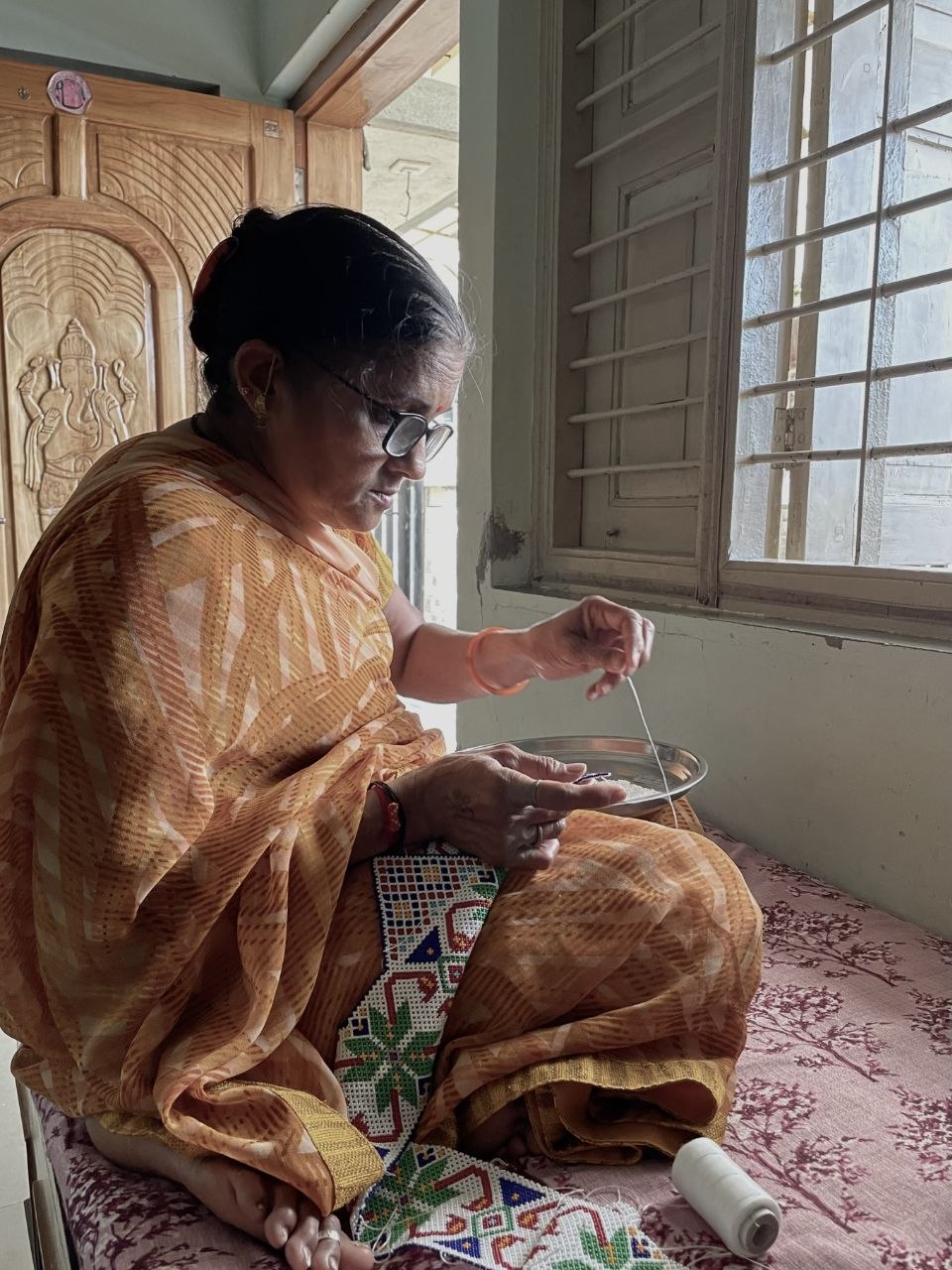
Jayaben doing beadwork at her home.
Beadwork may be done alone as a form of meditation or as a social activity with friends. Either way, it is commonly seen as a leisure-time activity. Women generally gather outside their homes, sit together and make their beadwork articles while talking to each other in the evening. Some of them also prefer doing beadwork in a quiet corner in their homes.

Women in Bhavnagar practising beadwork collectively.
In Saurashtra, beadwork is a trousseau textile. Beadwork handicrafts, along with other handmade textile pieces, are given to the bride when she moves into her in-laws’ house. A girl’s family would start preparing for her trousseau 5-6 years before her wedding.
Beadwork is called motikaam or porravvanu kaam in Gujarati. Embroidery is called bharat kaam or bharvanu kaam. Crochet and knitting is also done by these women. It is called guthvanu kaam. The textiles that the bride carries in her trousseau are a combination of all three techniques. The prestige of the bride’s family is measured by the amount of textiles and handicrafts she takes with her. The groom’s family also takes pride in the skill sets possessed by the new bride. Apart from trousseau handicrafts, women also make handicrafts for decorating their homes and for ceremonial purposes. Women embellish their homes with intricate embroideries and beadwork to add vibrancy to festive occasions. They commonly make products like toran, barsakhiya, chakla, aarti thali, kalash, mamat, lalan jhula, and more.

Ganesh Sthapana

Chakla

Toran
Women from the Patel, Kharak, and Darbar communities actively practice this craft. Earlier, other Gujarati communities also used to practise it, but with modernisation and people migrating to urban settlements, the craft has declined in popularity. The communities practising it today are the ones who take pride in their art and culture.
Earlier, they used stone beads, but now they mostly use glass beads that are imported into India from the Czech Republic.
There are different types of techniques followed by women in the same area. I got a gist of all of those. Based on the making technique, Bhavnagar’s beadwork can be categorised into khatli work and knitting with the needle. Khatli work involves using a loom for weaving beads, which is made by the male members of the family. Another way is to knit the beads with the needle, done manually. Most of the women practice knitting with the needle technique, as they don’t need a specific setup for it. They can easily work in their comfort zone.
I feel beadwork is a very suitable medium to generate employment for women. Acquiring the skill of beadwork lets them work in their own comfort zone and also generate a good amount of income for them.
This technique of knitting is called the tri-bead system. As the craftsperson takes 3 beads in every loop, it is called tran moti nu kaam. The grid formed by the arrangement of beads is a tessellation of diamonds. One may take any odd number of beads in one loop, and this grid will be achieved, but the size of individual diamonds will vary. Increasing the number of beads in a loop will cause the gaps between the loops to widen. Tran moti nu kaam is more popular in Bhavnagar. She can do any odd number of beads in one loop to achieve this type of grid. If more than 3 beads are taken in one loop, the surface becomes rigid and also loses firmness. Also, the design becomes less evident because of the widening of gaps. Compared to ek moti (1 bead taken at a time), tran moti is more efficient. The mono-bead system seems unimaginative and dry and lacks the net-like effect produced in the tri-bead system, where each figurative motif seems to be integrated into the dynamic surface of the beaded net. In addition, the design gets translated well, and the surface stays flexible and firm. In many products, they use a combination of different bead systems to make it more dynamic.

Mono-bead system

Tri-bead system

A system based on 13 beads
I realised that the visual language and motif vocabulary of many Gujarati crafts draw inspiration from the flora and fauna people see around them, along with well-known patterns like Bandhani and Laheriya. Their way of expressing what they observe is simple, yet full of warmth and care.
Many of these motifs were created a long time ago, and over time, the knowledge of developing new ones has reduced. Still, artisans who are deeply passionate about beadwork continue to experiment in their own ways and bring freshness to the craft.
What I really admire is how simple ideas are translated so beautifully through different techniques. It fascinates me how the same motif, like a peacock, looks so different in beadwork compared to Bandhani or Rabari embroidery. This shows how the maker respects the technique and adapts the design to it, rather than forcing a design onto it. The beadwork artisans are also naturally trained to think in a diamond grid, and they can clearly visualise designs within that structure.
The women making beadwork handicrafts are extremely patient. Tangling and detangling of threads is a very integral part of their task. They never complain or get irritated by it. They always resolve the error with a smile. They never hesitate to open the part they had already made and redo it, if needed. They make it with immense love. Watching uneducated or less educated women have great mathematical knowledge and understanding of the grid is truly moving. The place where they work is very quiet and peaceful.
It is a women-centred craft, but as a means of earning, some men also practice. By looking at the handicrafts, one can appreciate the beauty of the grid and how motifs appear. The motifs are aligned with the grid. Most of the women do not know how to create new motifs. So they replicate the designs from an existing sample. Most of them are not even aware of the meaning and significance of all the motifs. They just know that they bring good omen.
The idea of a shared culture and collective creativity is very evident, as these women freely share their beaded designs with each other. They often take inspiration from one another, sometimes combining motifs from two or three different pieces to create their own designs. When they buy beads, they often ask for a sample for their reference, and the shopkeeper never hesitates to give one. We could also see a stark contrast between the women who practise this craft for their families and the ones who run businesses. The former ones were more open to sharing their knowledge with me. The latter had a monopoly on their technique and management system, so they didn’t open up much.
The trousseau tradition is slowly disappearing in Saurashtra. Now that daughters are getting educated, their families feel that they don't need to gift a lot of handicrafts to them. A craft is mostly portrayed as an alternative to education, rather than as complementary.
I feel that most handicrafts began as a part of daily life. They were naturally woven into people’s routines. Today, buying a handcrafted piece has become a conscious choice, almost like a special event. Because of this, there is now a need to explain their value, even though these objects were originally designed to fit seamlessly into everyday life. They were made with a clear understanding of materials, context, and the needs of people.
At the same time, it is encouraging to see people making conscious efforts to keep these crafts alive and adding their own interpretations. Freshness is important for any craft to survive. What we see today has also evolved from earlier practices. So, it becomes important to understand where the craft stands today, how it has evolved, and then think about where it can go in the future.
I hope to continue understanding, documenting, and finding ways to keep these traditions relevant. <3


